
Artificial intelligence in business: save time, boost productivity and avoid the pitfalls
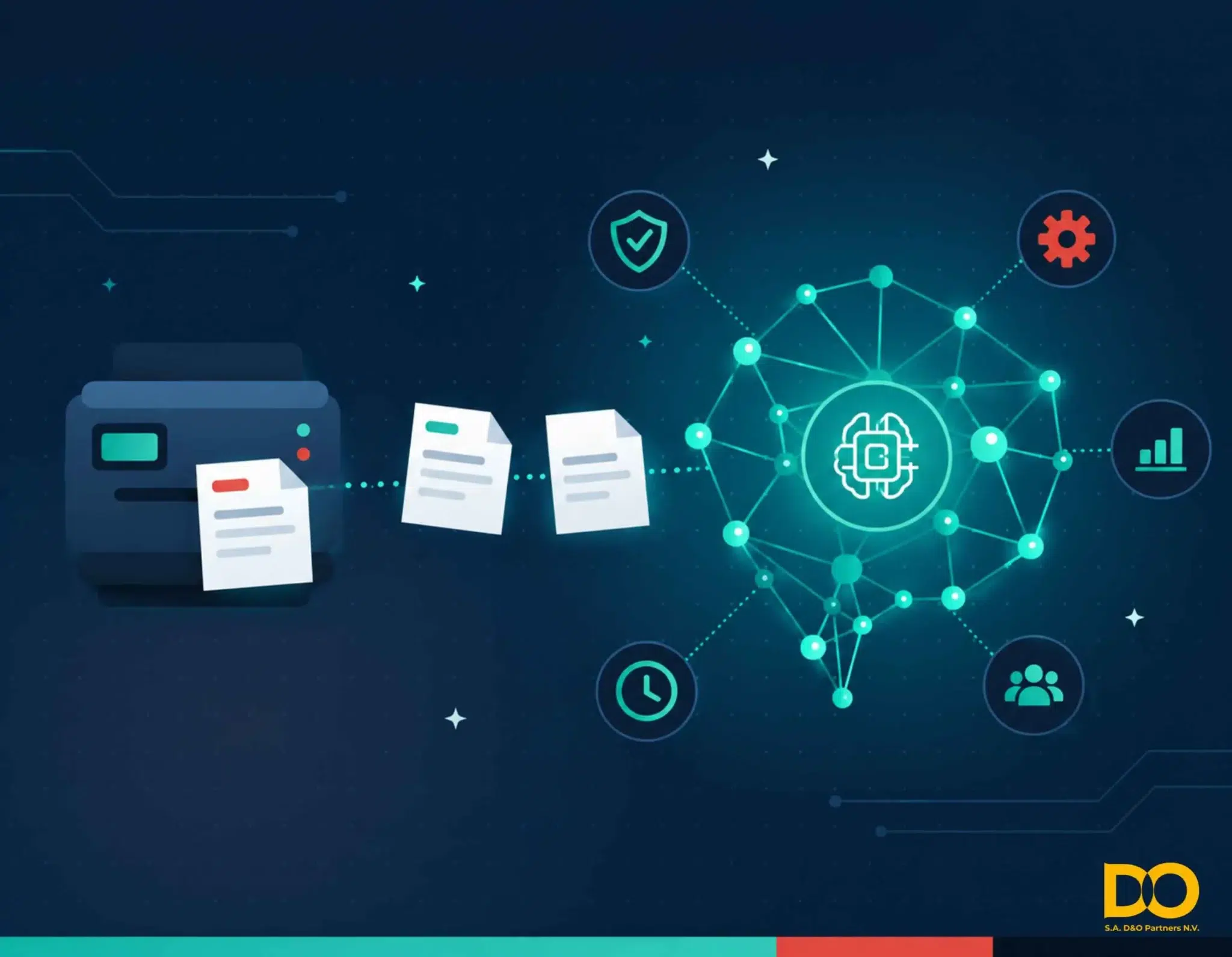
Artificial intelligence in business refers to the use of generative models (ChatGPT, Claude, Copilot, Gemini) to automate repetitive tasks, analyse data and support teams in their decisions. Well integrated, it saves dozens of hours every month and replaces many standalone subscriptions; poorly managed, it exposes you to data leaks and non-compliance (GDPR, AI Act). Structured guidance means auditing your processes, assessing every opportunity, training your staff and integrating AI securely. D&O Partners, Xerox partner and specialist in printing and document management solutions in Brussels since 1992, supports Belgian SMEs and self-employed professionals together with Beewa, from the initial audit to full deployment.
Why so many corporate AI projects fail
In 2026, almost every company is ‘doing AI’. In reality, most of it comes down to a few prompts in a free chatbot such as ChatGPT, with no method, no strategy and no measurement of results. MIT’s finding (NANDA project, 2025) is harsh: around 95% of generative AI pilot projects deliver no measurable return.
Three causes come up time and again:
- No priority use case: everything gets tested, without identifying each activity’s real need or defining an objective.
- A lack of training: employees use less than 10% of the capabilities of the AI tools their company pays for.
- Fear of the dangers: confidential data, errors, regulation — without a framework, nobody dares to develop new uses.
Structured guidance turns this anecdotal use into a measurable performance lever for the business.
Save money: replace dozens of standalone services
Most SMEs stack up specialised subscriptions: meeting transcription (Otter.ai, Fireflies), proofreading (Grammarly, Antidote), marketing copy (Jasper, Copy.ai), professional translation (DeepL Pro), content and visual creation, market intelligence… Added together, they represent €300 to €600 per month, i.e. €3,600 to €7,200 per year for a small team.
Yet a single modern platform — ChatGPT (OpenAI), Claude (Anthropic), Copilot (Microsoft 365) or Gemini (Google) — covers most of these functions with equivalent quality, provided the AI is correctly configured. This is dé-stacking: one single, efficient foundation, configured to your company’s precise needs.
| Typical standalone service | Example solutions | Typical monthly cost | Covered by the platform |
| Meeting transcription | Otter.ai, Fireflies | €15–30/user | Yes |
| Proofreading and rewriting | Grammarly, Antidote | €10–30/user | Yes |
| Marketing copywriting | Jasper, Copy.ai | €40–100/month | Yes |
| Everyday translation | DeepL Pro | €10–30/user | Yes |
| Document summaries | Dedicated applications | €10–20/user | Yes |
| Monitoring and analysis | Specialised services | €50–150/month | Largely |
Key takeaway: the goal is not to add another subscription, but to remove five or six. The audit quantifies the annual saving before any decision.
Before / after: what AI changes in practice
| Indicator | Before guidance | After guidance |
| Subscriptions and licences | 5 to 8 standalone services (€300–600/month) | 1 to 2 platforms: 50–70% savings |
| Time spent on repetitive tasks | 6 to 10 h per week per employee | 3 to 5 h recovered every week |
| Data leaks | Untracked usage: 72% bypasses the IT department (Cyberhaven, 2024) | Charter, approved solutions, classified data |
| Compliance | GDPR / AI Act exposure not assessed | Uses mapped, documented governance |
| Skills | 1 or 2 isolated ‘power users’ | Trained, autonomous teams |
Save time across every business function
Administration, sales, marketing, customer service: every department loses hours to repetitive tasks — standard emails, formatting quotes, meeting summaries, sorting incoming requests, answering recurring questions, analysing sales data. The Microsoft Work Trend Index (2024) shows that regular users of intelligent assistants recover several hours a week — provided they are trained.
- Map the repetitive tasks of each activity and how users actually behave.
- Prioritise those where AI helps most, with the least risk — rarely the ones you think of first.
- Equip and train: reusable prompts, document templates, configured assistants, upskilling of staff.
These gains require no heavy IT project: the platforms are already available. They also follow on naturally from efficient document management: the scanning and archiving of your documents often form the foundation on which AI builds further automation. The key is to give each team use cases that fit the way it works. Typical order of magnitude: 3 to 5 hours saved per employee per week, from the very first month. The real success metric: time actually recovered, reinvested in your core business and customer experience.
Avoid the pitfalls: the 5 dangers we secure
Without a framework, artificial intelligence exposes the company to documented — and quantified — risks. Knowing these dangers is the first protection; managing them is our job.
1. Hallucinations
A language model can invent things with complete confidence: false figures, non-existent legal references. The problem: without verification, these errors end up in your quotes and contracts. We put precise review rules in place, adapted to how critical each use is — for informed decisions.
2. Confidential data leaks
Pasting a client contract into a public chatbot constitutes processing of personal data and may breach the GDPR. According to Cyberhaven (2024), 11% of the data employees paste into ChatGPT at work is confidential; and the volume sent to generative apps has increased sixfold in one year (Netskope, 2026). We define which information may go where: approved solutions, security settings, prohibited categories. This vigilance also extends to your print fleet: the Xerox multifunction devices we install come with advanced security features (encryption, access control, intrusion protection), so your documents stay protected from screen to paper.
3. Shadow AI
68% of employees who use AI do so without telling their managers (IFOP-Talan survey); 20% of organisations have suffered a data breach linked to this phenomenon (IBM, Cost of a Data Breach, 2025). Banning makes these uses invisible; framing them makes them manageable. Our answer: a clear framework and approved AI tools, simpler than hidden use.
4. Non-compliance (AI Act, GDPR)
Regulation (EU) 2024/1689 applies in stages: a major deadline on 2 August 2026 for high-risk systems (recruitment, credit, health, biometrics). Penalties: up to €35 million or 7% of worldwide turnover. Even simple AI-assisted CV screening can bring an SME within the scope of the text. We map your uses and provide the documented management of your compliance.
5. Dependency
A team that can no longer produce without an assistant is fragile. Our principle: technology should strengthen skills, not replace them. Everyone learns to understand, judge and improve what the machine produces, and to weigh different viewpoints rather than accept a single ready-made answer.
Our method: integrating AI in 4 steps
| Step | Content | Deliverable |
| 1. Audit | Analysis of processes, subscriptions and their costs; shadow AI detection; risk assessment | Quantified opportunity report |
| 2. Roadmap | Strategic prioritisation by impact and sector; rollout adapted to your maturity | Tailor-made plan |
| 3. Deployment and training | Set-up of platforms, prompts and AI tools; hands-on training by role | Autonomous teams, usage charter |
| 4. Follow-up | Steering performance, measuring gains, monitoring trends and regulation | Quarterly review: time saved, costs avoided, compliance |
Each step can be carried out separately. D&O Partners adapts the format to your size, your sector and your experience.
Who is it for?
Our offering is aimed at any organisation that wants to discover, in a structured way, what these technologies can bring to its operations:
- Belgian SMEs, micro-businesses and self-employed professionals who want to structure still-informal use and make adoption easier for their teams.
- Management teams that demand clear governance of security and compliance before scaling up.
• Teams already using AI that have hit a ceiling: automations, agents, integration with CRM, customer service and business development.
FAQ — Artificial intelligence in business
What is AI guidance?
A service combining audit, selection of the right platforms, training and a security framework, to deliver measurable results — hours saved, costs cut — without creating new risks.
How much can an SME save?
Removing redundant subscriptions often represents €3,600 to €7,200 per year, and the productivity gain 3 to 5 hours per employee per week. The audit quantifies both for your situation.
Is AI dangerous for a company?
Without a framework, yes: hallucinations, data leaks, shadow AI and non-compliance are documented risks. Properly managed — approved solutions, human verification, training — it is a controlled performance lever.
Do you need to be a large organisation to get support?
No. Micro-businesses, SMEs and self-employed professionals get the most value from it: without a dedicated IT department, every hour saved counts for more.
What is shadow AI?
The use of artificial intelligence applications without the employer’s approval. The effective answer: provide a framework and approved solutions rather than a ban.
Is my business affected by the AI Act?
If you use AI for recruitment, credit, health or biometrics, very probably. A precise mapping will determine this, ahead of the 2 August 2026 deadline.
How long does a guidance programme take?
An audit: a few days to a few weeks. A full programme: 2 to 4 months, with concrete results from the very first weeks.
Article published by D&O Partners, Xerox partner and specialist in printing and document management solutions in Brussels, in collaboration with Beewa, expert in AI guidance for SMEs in Belgium, July 2026. Want to assess AI’s potential in your organisation? Contact us.
Sources and references
Cyberhaven (2023), ‘11% of data employees paste into ChatGPT is confidential’, analysis covering 1.6 million employees: https://www.cyberhaven.com/blog/4-2-of-workers-have-pasted-company-data-into-chatgpt
IFOP and Talan (2023), survey ‘Les Français et les IA génératives’: https://www.talan.com/global/fr/sondage-ifop-talan-les-francais-et-les-ia-generatives
MIT, NANDA project (2025), report ‘The GenAI Divide: State of AI in Business 2025’, summarised by Fortune: https://fortune.com/2025/08/18/mit-report-95-percent-generative-ai-pilots-at-companies-failing-cfo/
IBM (2025), ‘Cost of a Data Breach Report’: https://www.ibm.com/reports/data-breach
Microsoft (2024), ‘Work Trend Index’: https://www.microsoft.com/en-us/worklab/work-trend-index
Netskope Threat Labs (2026), ‘Cloud & Threat Report’: https://www.netskope.com/netskope-threat-labs
European Union (2024), Regulation (EU) 2024/1689, the ‘AI Act’: https://eur-lex.europa.eu/eli/reg/2024/1689/oj