


Sheet fed production printers are ideal for graphic communications and commercial print providers’ high-speed, high-volume printing applications, including publishing, transaction printing, print on demand and one-to-one marketing. Our high-volume digital printing press models and production printers and copiers combine vibrant colour, monochrome or highlight colour with high speed and productivity.
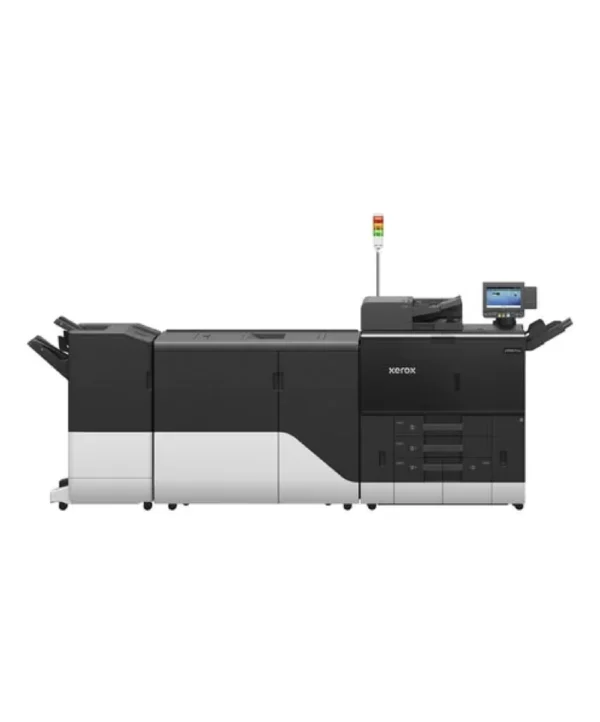
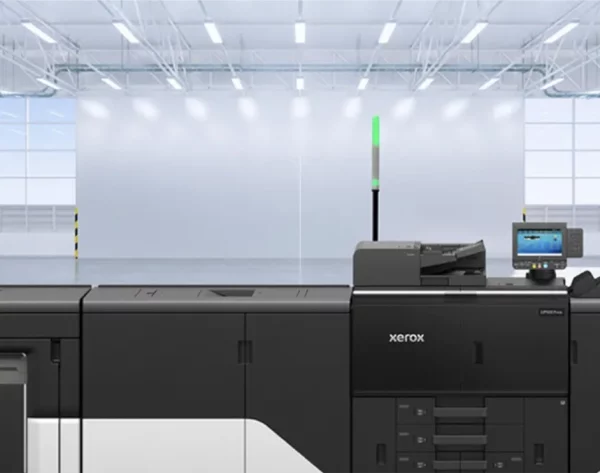
Xerox IJP900 Inkjet Press
The Xerox IJP900 is a cut-sheet inkjet production press, built for organisations printing very high volumes of documents: transactional print operations, mail and document centres in finance, healthcare, insurance, public administration and education, as well as individuals or clients whose runs are counted in hundreds of thousands of pages. Its promise fits in one sentence: inkjet without the complexity. At 150 pages per minute in colour as in black and white, it absorbs a recommended volume of 250,000 to 1,000,000 pages per month, simplex or duplex, with scanning included as standard.
Its most distinctive asset is what it does not require: no special infrastructure. It runs on a standard power supply, with no air conditioning system, no water connection, no complex fit-out — a direct saving in time, space and installation budget, reinforced by a compact footprint that grows with your needs through optional additional paper feeders and stacking and finishing modules, up to 14,310 sheets of paper capacity. Total cost of ownership follows the same logic: large 3-litre ink reservoirs and intelligent maintenance reduce manual interventions, so you print more while keeping costs tight. The supported media — plain, uncoated, super-smooth and inkjet-treated papers in matte, silk or plain finish — match exactly the high-volume management and communication documents this press is made for.
Compared with the Proficio PX500, the toner press at the top of our cut-sheet range, the choice is between two trades: the IJP900 is faster (150 pages per minute versus 100) and climbs higher in volume (up to 1,000,000 recommended pages per month versus 350,000), with minimal infrastructure and running costs — the transactional document machine. The PX500 keeps the edge on graphic work: coated, glossy and synthetic stocks up to 400 gsm, and Beyond CMYK inks for embellishments, which the IJP900 does not cover. Statements, invoices and high-volume mailings: IJP900; premium brochures and graphic jobs: PX500. Our advisers will settle it with you based on your actual document mix.
At D&O Partners, the Xerox IJP900 is available for purchase or leasing, with site study, installation and configuration by our certified technicians, across Belgium. Our maintenance contracts include on-site support and consumables delivered within 48 hours — the continuity of a document production chain is non-negotiable. Request a quote or a demonstration: we size against your actual volumes.
FAQ:
What is the difference between the IJP900 and the Proficio PX500?
Two technologies, two trades: the IJP900 (inkjet) is faster (150 pages/min versus 100) and climbs to 1,000,000 recommended pages per month, with minimal infrastructure — ideal for very high-volume transactional printing. The PX500 (toner) keeps the graphic edge: coated and glossy stocks up to 400 gsm and Beyond CMYK inks, which the IJP900 does not cover.
What volume is the IJP900 recommended for?
From 250,000 to 1,000,000 pages per month — the calibre of a document centre or mail operation in finance, healthcare, insurance, public administration or education. Our certified technicians will validate the sizing against your actual volumes.
Does the IJP900 require special facilities?
No — that is its signature: it runs on a standard power supply, with no air conditioning, water connection or complex fit-out. Installation is faster and cheaper, and the press fits in a compact production space.
How does the IJP900 reduce cost per page?
Through its large 3-litre ink reservoirs, intelligent maintenance and fewer manual interventions: less downtime, less handling, and a controlled total cost of ownership at high volumes.
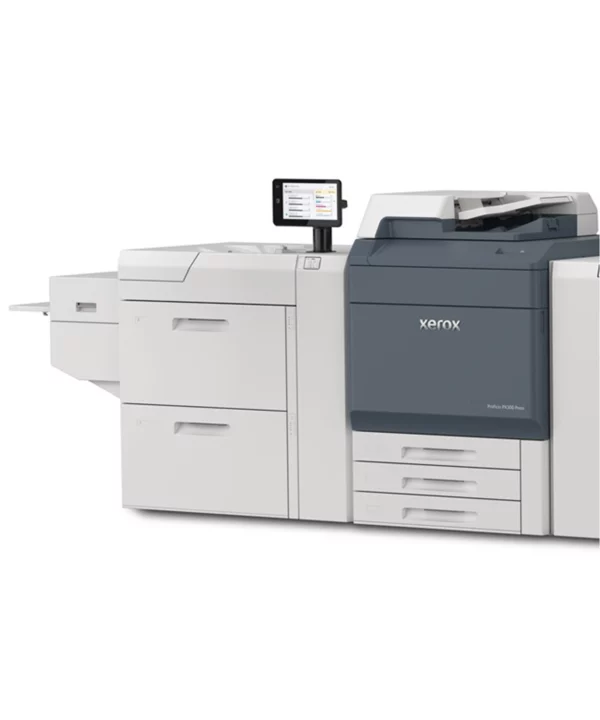
Xerox Proficio PX300 Production Press
The Xerox Proficio PX300 is a colour production press built for organisations where printing is the trade or the core business: small print shops, repro departments, production sites and print franchises, as well as individuals or clients whose volumes have outgrown an office multifunction device. With a pace of 85 pages per minute, a recommended volume of 150,000 pages per month and a ceiling of 750,000 pages, it combines press-grade capacity with a compact, flexible footprint that fits in without rebuilding the shop. Copying and scanning are included as standard alongside colour printing.
Its decisive everyday advantage: rated speed is maintained on all stocks, up to 400 gsm — business cards, envelopes, labels, tab inserts, embossed papers, synthetic media and extra-long banners run at the same pace as standard paper, with mixed-media runs supported. The optional fifth colour station unlocks the specialty Beyond CMYK inks, putting professional-grade embellishments within reach of every job. Control runs through dedicated Fiery print servers (Xerox EX PX300 or EX-Li PX300), and serious production options follow: closed-loop colour density and registration control, static elimination, progress indicator, and full finishing — booklet making, cutting, slitting and folding, folder unit, hole punching, inline binding, offset output tray — to deliver finished documents straight off the machine.
Compared with the PrimeLink C9200, its neighbour in the D&O Partners range, the maximum stock weight is identical (400 gsm) but the scale changes: the PX300 is recommended for 150,000 pages per month where the C9200 tops out at 60,000, with a maximum cycle of 750,000 pages versus 300,000 — and it adds Beyond CMYK inks and closed-loop quality control, which belong to the press world. The C9200 remains the right choice for versatile in-house repro; the PX300 begins where printing becomes daily production. And if your volumes aim even higher, the Proficio range continues with the PX500 — our advisers will help you size it right.
At D&O Partners, the Proficio PX300 is available for purchase or leasing, with site study, installation and Fiery server configuration by our certified technicians, across Belgium. Our maintenance contracts include on-site support and cartridges delivered within 48 hours — vital when the press produces every day. EPEAT and ENERGY STAR certified, it is covered by the Xerox cartridge collection programme for recycling your used consumables. Request a quote or a demonstration: we’ll talk real volumes, not brochure claims.
FAQ:
What is the difference between the Proficio PX300 and the PrimeLink C9200?
Maximum stock weight is identical (400 gsm), but the scale differs: the PX300 is recommended for 150,000 pages per month (750,000 ceiling) versus 10,000 to 60,000 for the C9200 (300,000 ceiling), and it adds the fifth station with Beyond CMYK inks and closed-loop quality control. The C9200 suits versatile in-house repro; the PX300 is a true press for organisations producing daily.
What volume is the Proficio PX300 recommended for?
150,000 pages per month in recommended use, with a maximum cycle of 750,000 pages — the calibre of a small print shop, a repro department or a production site. Our certified technicians will validate the sizing against your actual volumes.
What do Beyond CMYK inks enable?
The optional fifth colour station hosts specialty inks beyond standard four-colour printing, for professional-grade embellishments that make your work stand out — invitations, packaging, covers and premium marketing materials.
Is the Proficio PX300 an eco-responsible choice?
Yes: it is EPEAT and ENERGY STAR certified, and D&O Partners pairs it with the Xerox cartridge collection programme to recycle your used consumables.
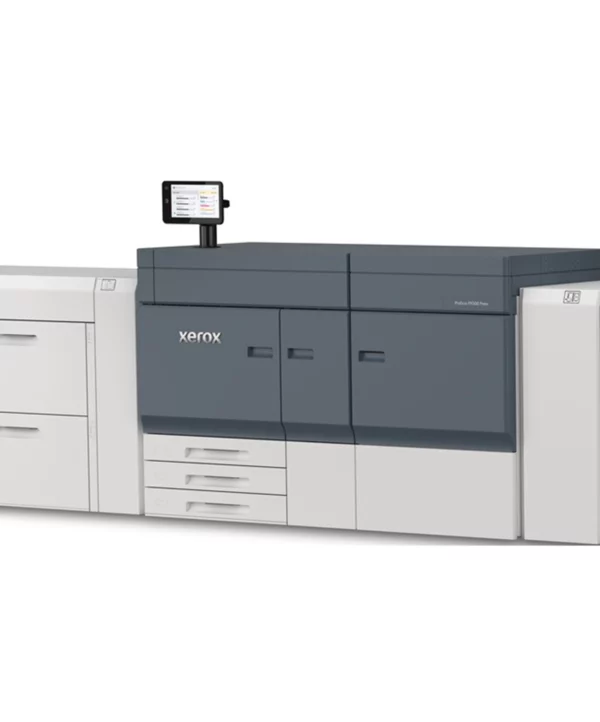
Xerox Proficio PX500 Production Press
The Xerox Proficio PX500 is the top of the Proficio range: a colour production press for print shops, repro departments and production sites whose volumes are counted in hundreds of thousands of pages — up to 350,000 pages per month in recommended use, with a ceiling of 1,800,000 pages. At 100 pages per minute, it is built for individuals or clients whose production runs at full capacity and for whom every machine stop has a price tag. Its philosophy: built-in automation and intelligent workflows reduce operator touchpoints, so a smaller team can handle more work with production kept in sync with the next steps.
Like its smaller sibling the PX300, it maintains rated speed on all stocks, up to 400 gsm: business cards, envelopes, labels, tab inserts, embossed papers, synthetic media and custom solutions run without slowing down, mixed-media jobs included. The optional fifth colour station extends the palette with specialty Beyond CMYK inks to unlock premium applications, and closed-loop colour density and registration control keeps image quality constant over long runs. Control rests on dedicated Fiery print servers (Xerox EX-P PX500 or EX PX500), and inline finishing — booklet making, cutting, slitting and folding, folder unit, hole punching, binding — delivers finished documents straight off the machine.
Compared with the Proficio PX300, the range’s entry point, stocks (400 gsm at rated speed), Beyond CMYK inks and finishing are identical — it is the scale that changes: 100 ppm versus 85, a recommended volume of 350,000 pages per month versus 150,000, a ceiling of 1,800,000 pages versus 750,000. One functional difference deserves attention: the PX300 includes copying and scanning as standard, while the PX500 is a pure printing press, driven by workflows with its built-in automation. If your shop still needs a copy station and is entering production, the PX300 is the right entry point; if printing is your daily production line, the PX500 is sized for it.
At D&O Partners, the Proficio PX500 is available for purchase or leasing, with site study, installation and Fiery server configuration by our certified technicians, across Belgium. Our maintenance contracts include on-site support and cartridges delivered within 48 hours — production continuity is our priority, as it is yours. EPEAT and ENERGY STAR certified, the press is covered by the Xerox cartridge collection programme for recycling your used consumables. Request a quote or a demonstration: we size against your actual volumes, not the brochure.
FAQ:
What is the difference between the Proficio PX500 and the Proficio PX300?
Stocks (400 gsm at rated speed), Beyond CMYK inks and finishing are identical; the scale changes: 100 ppm versus 85, 350,000 recommended pages per month versus 150,000, a ceiling of 1,800,000 pages versus 750,000. One more difference: the PX300 includes copying and scanning as standard, while the PX500 is a pure printing press with built-in automation. Our advisers will size it against your actual volumes.
What volume is the Proficio PX500 recommended for?
350,000 pages per month in recommended use, with a maximum cycle of 1,800,000 pages — the calibre of a print shop or production site where the press runs at full capacity every day.
What does the PX500’s built-in automation bring?
Intelligent workflows reduce operator touchpoints: a smaller team manages more jobs, and production stays in sync with the next steps — a direct lever on labour cost per run.
Is the Proficio PX500 an eco-responsible choice?
Yes: it is EPEAT and ENERGY STAR certified, and D&O Partners pairs it with the Xerox cartridge collection programme to recycle your used consumables.
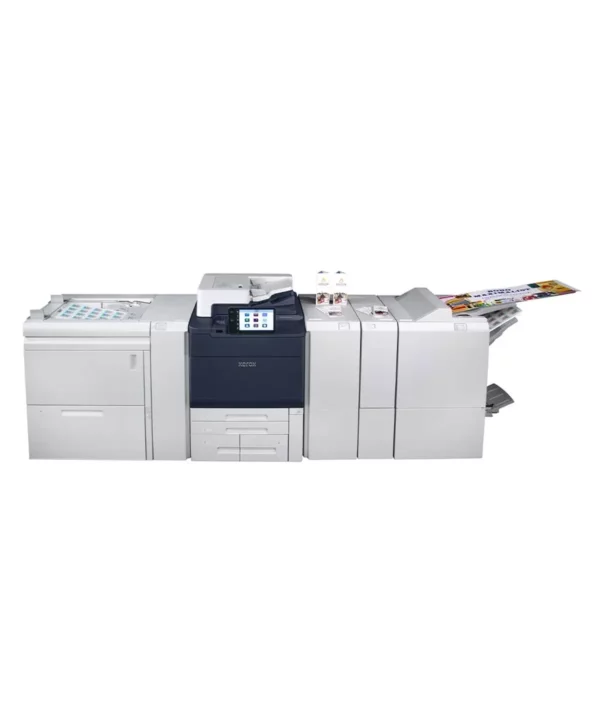
Imprimante Xerox® PrimeLink® C9200 Series
The Xerox PrimeLink C9200 Series — three models: C9265, C9275 and C9281 — is built for in-house repro departments, print providers, graphic studios and businesses or public administrations producing 10,000 to 60,000 pages per month, as well as for individuals or clients who want to produce professional-grade print work in-house. Thanks to LED print technology and EA HD toner, the series delivers 2400 x 2400 dpi resolution with sharp images and rich colours that stay consistent run after run.
In practice, this is the machine for shops handling very different jobs in a single day: stapled reports in the morning, folded booklets at noon, envelopes and large-format banners after that. It handles stocks up to 400 gsm and extra-long sheets up to 1,300 mm, with a full range of finishing options — stapling, booklet making, folding, creasing, hole punching, cutting, slitting and trimming. Each model matches a production pace: 65 ppm for the C9265, 75 ppm for the C9275 and 81 ppm for the C9281, with capacity of up to 300,000 pages per month at peak. The tablet-like touch interface simplifies every step, Xerox FreeFlow solutions automate production workflows, and XMPie enables personalised marketing campaigns. The built-in Xerox print server comes as standard, with Fiery servers available as an option. On the connectivity side, the series supports remote management, connects to cloud solutions and includes mobile printing via @PrintByXerox, while IP filtering, authentication and optional Common Access Card technology protect your sensitive data and documents.
Compared with the PrimeLink C9065/C9070, its neighbour in the same family, the C9200 steps up a level: it prints faster (up to 81 ppm versus 70), handles heavier stocks (400 gsm versus 350) and sheets twice as long (1,300 mm versus 660), with a built-in print server as standard. If your volumes or formats exceed what the C9065/C9070 can handle, the C9200 is the logical choice; if your priority is special effects in vivid or fluorescent colours, the C9065/C9070 with its CMYK Plus toners remains the reference in the range.
At D&O Partners, the PrimeLink C9200 Series is available for purchase, rental or leasing, with installation and configuration by our certified technicians, across Belgium. Our maintenance contracts include on-site support and cartridges delivered within 48 hours. Energy-efficient thanks to its LED technology and recyclable components, the series is covered by the Xerox Green World Alliance take-back programme for recycling used consumables — high output without a heavy environmental footprint.
FAQ:
What is the difference between the PrimeLink C9200 and the PrimeLink C9065/C9070?
The C9200 is the higher tier of the same family: faster (65, 75 or 81 ppm depending on the model, versus 65-70 ppm), with media up to 400 gsm (versus 350) and extra-long sheets up to 1,300 mm (versus 660), plus a built-in print server as standard. The C9065/C9070, however, retains exclusive access to the specialty CMYK Plus toners (vivid and fluorescent colours).
How do I choose between the C9265, C9275 and C9281 models?
All three share the same functions (copy, print, scan) and the same finishing options; only the speed differs: 65, 75 or 81 ppm. All are recommended for 10,000 to 60,000 pages per month — our certified technicians will help you size the right model for your production peaks.
What media can the PrimeLink C9200 Series print on?
From envelopes to extra-long 1,300 mm sheets, on stocks up to 400 gsm: stationery, brochures, covers and large-format banners, with integrated finishing (booklets, folding, creasing, trimming).
Is the PrimeLink C9200 Series an eco-responsible choice?
Yes: its LED technology is energy-efficient, its components are recyclable, and D&O Partners pairs it with the Xerox Green World Alliance take-back programme to recycle used consumables.
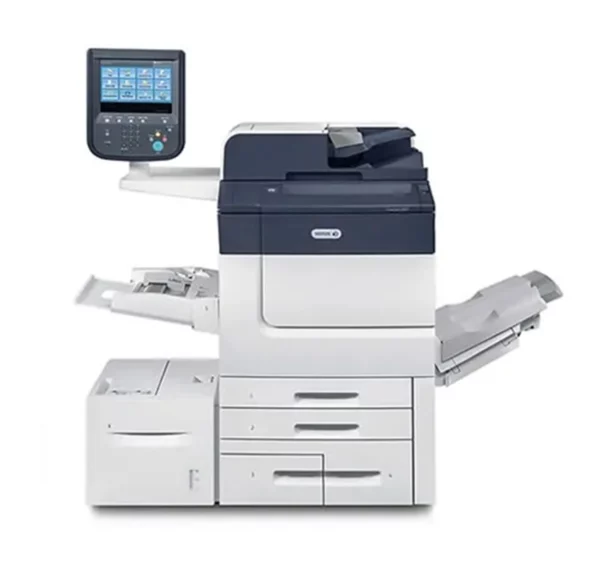
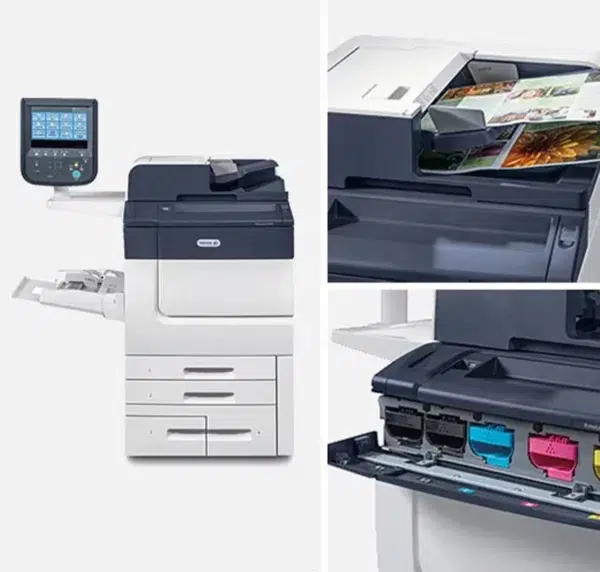
Xerox PrimeLink C9065/C9070 Production Colour Printer – Xerox
The Xerox PrimeLink C9065/C9070 is a light-production A3 colour multifunction printer built for in-house repro departments, communication agencies, public administrations and businesses printing between 10,000 and 50,000 pages per month, as well as for individuals or clients looking for near-print-shop quality without moving up to a digital press. With 2400 x 2400 dpi resolution and speeds of up to 65 ppm in colour (70 ppm in black) on the C9065, and up to 70 ppm in colour (75 ppm in black) on the C9070, it delivers crisp documents with smooth colour transitions, even at high output.
Day to day, this is the machine for jobs that need to come out finished: stapled brochures, folded booklets, punched documents, up to 330 x 660 mm banner formats and heavy stocks of 350 gsm. Professional finishing options — stapling, folding, hole punching, booklet making, trimming and slitting, inline binding — deliver ready-to-distribute documents with no manual steps. Optional EFI servers with PANTONE® technology ensure faithful colour, and the specialty CMYK Plus toners (vivid and fluorescent colours, optional) add impact to materials that need to stand out. On the workflow side, the device connects directly to Microsoft OneDrive, Google Drive and Dropbox for cloud printing and scanning, while @PrintByXerox lets your teams print securely from their mobile devices without installing any software. Security is built in at every level: data encryption, access controls, secure print release and audit logs for full traceability.
Compared with the VersaLink C9000, its neighbour in the range, the difference is clear: the VersaLink C9000 is a colour printer aimed at graphic professionals, limited to 55 ppm and print-only, whereas the PrimeLink C9065/C9070 is a full multifunction device (copy, print, scan, email) that is faster, offers twice the resolution and provides production-grade finishing. If your volumes exceed 30,000 pages per month or you need finished booklets and brochures in-house, the PrimeLink is the right choice.
At D&O Partners, the PrimeLink C9065/C9070 is available for purchase, rental or leasing, with installation and configuration by our certified technicians, across Belgium. Our maintenance contracts include on-site support and cartridges delivered within 48 hours. EPEAT and ENERGY STAR certified, the device is also covered by the Xerox take-back programme for recycling used consumables — a high-performance, eco-responsible solution from quote to end of life.
FAQ:
What is the difference between the PrimeLink C9065/C9070 and the VersaLink C9000?
The VersaLink C9000 is a colour printer (print-only, 55 ppm) aimed at graphic professionals. The PrimeLink C9065/C9070 is a full multifunction device — copy, print, scan, email — that is faster (up to 70 ppm in colour), with 2400 x 2400 dpi resolution and production finishing such as booklet making and inline binding.
What print volume is the PrimeLink C9065/C9070 recommended for?
It is designed for 10,000 to 50,000 pages per month, making it ideal for in-house repro departments and organisations with high document output.
What does CMYK Plus technology add?
The optional vivid and fluorescent toners create effects that standard four-colour printing cannot, for invitations, posters or marketing materials that catch the eye instantly.
Is the PrimeLink C9065/C9070 an eco-responsible choice?
Yes: it is EPEAT and ENERGY STAR certified, and D&O Partners pairs it with the Xerox take-back programme to recycle used consumables.
Digital Colour Printing Press Versant 280 – Xerox
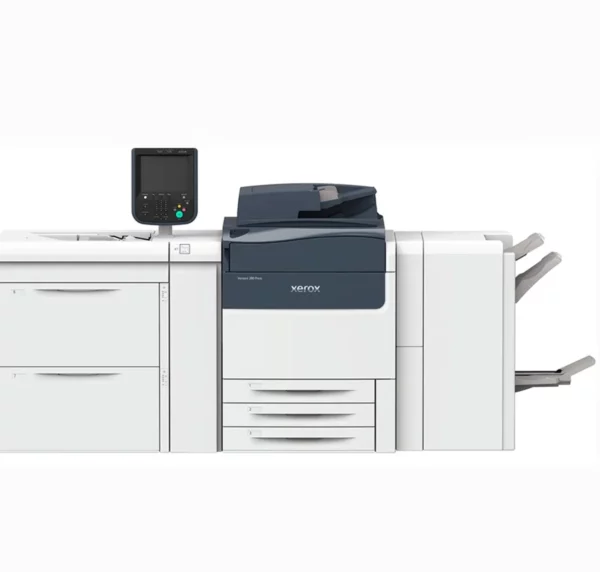
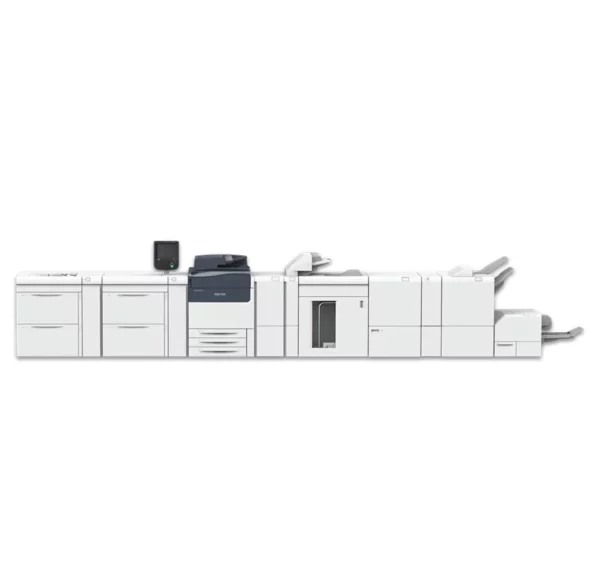
The Xerox Versant 280 is a digital colour press built for mid-volume production environments: print shops, repro departments, in-house print services, communication agencies, as well as individuals or clients who want to turn their print capacity into a revenue stream. With a recommended volume of 150,000 pages per month and a ceiling of 750,000, it brings printing, copying and inline scanning together in one field-proven all-in-one machine, driven by dedicated Fiery servers (Xerox EX 280 or EX-i 280) and accelerated by the predefined workflows of FreeFlow Core Accelerator.
Its media versatility is its first commercial asset: formats from 98 x 146 mm up to 330 mm x 1.2 m banners, on stocks reaching 400 gsm — envelopes, labels, tab inserts, synthetics and vinyls included, in mixed-media runs. The Ultra HD 2400 x 2400 dpi resolution, served by EA toner and SIQA uniformity and alignment technology, guarantees consistent colour coherence. And to make your work stand out, the exclusive Adaptive CMYK+ kit swaps the CMYK toners with the Vivid and Fluorescent kits: gold, silver, white, clear, or fluorescent cyan, magenta and yellow — billable premium applications without changing machines. Two options structure the ramp-up: ASRS (All Stocks Rated Speed), printing 25% faster on all stocks up to 400 gsm, and the Performance Package, which adds an inline X-Rite spectrophotometer and the ACQS suite for fully automated colour management, from calibration to control, eliminating variability and human error. Finishing options range from simple folding and stapling to square-fold, full-bleed booklets.
Compared with the IJP900 inkjet press, its catalogue neighbour, the choice is between two trades: the IJP900 climbs higher in volume (up to 1,000,000 recommended pages per month versus 150,000) on standard papers — the transactional machine — while the Versant 280 rules the graphic field with its heavy and specialty stocks, its 1.2 m banners and its Adaptive CMYK+ toners that inkjet does not cover. Premium brochures, packaging and creative work: Versant 280; statements and mass mailings: IJP900. And if your graphic volumes outgrow this calibre, the Versant family continues with the Versant 4100 — our advisers will size it with you.
At D&O Partners, the Versant 280 is available for purchase or leasing, with site study, installation and Fiery server configuration by our certified technicians, across Belgium. Our maintenance contracts include on-site support and consumables delivered within 48 hours — including the specialty Vivid and Fluorescent toners. EPEAT and ENERGY STAR certified, the press fits into a sustainable operating approach. Request a quote or a demonstration in our Brussels showroom: we’ll talk profitable applications, not brochure claims.
FAQ:
What is the difference between the Versant 280 and the IJP900 inkjet press?
Two trades: the IJP900 climbs to 1,000,000 recommended pages per month on standard papers — ideal for transactional printing — while the Versant 280 (150,000 recommended pages, 750,000 max) dominates the graphic field: coated, synthetic and vinyl stocks up to 400 gsm, 1.2 m banners and specialty Adaptive CMYK+ toners that inkjet does not offer.
What volume is the Versant 280 recommended for?
150,000 pages per month in recommended use, with a maximum cycle of 750,000 pages — the calibre of a mid-volume production environment: print shop, repro department or in-house print service. Our certified technicians will validate the sizing against your actual volumes.
What does the Adaptive CMYK+ kit enable?
Easily swapping the CMYK toners with the Vivid and Fluorescent kits: gold, silver, white, clear, or fluorescent cyan, magenta and yellow. Enough to offer premium applications — invitations, covers, packaging — and diversify your print services without investing in a second machine.
Is the Versant 280 an eco-responsible choice?
Yes: it is EPEAT and ENERGY STAR certified, and D&O Partners supports you with sustainable consumables management throughout the maintenance contract.
PrimeLink B9100 Printer Series – Xerox
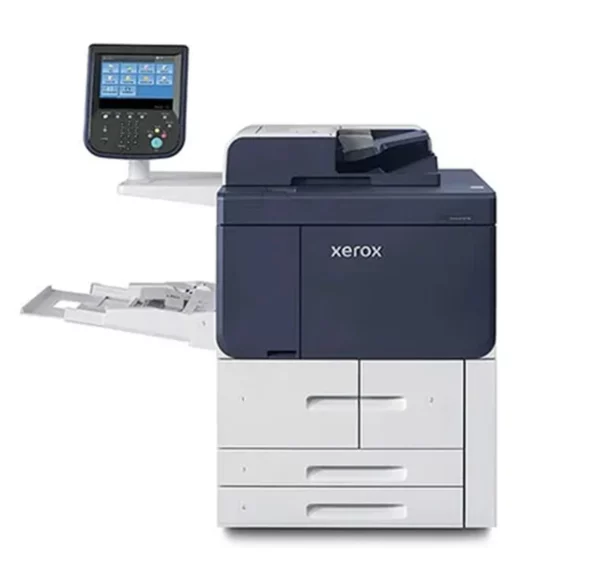
The Xerox PrimeLink B9100 Series comprises four monochrome production multifunction printers — B9100, B9110, B9125 and B9136 — built for repro centres, in-house print rooms, public administrations and organisations in retail, education and healthcare handling 70,000 to 700,000 pages per month, as well as for individuals or clients who have so far outsourced their high-volume black-and-white runs. Each model matches a pace: 100 ppm for the B9100, 110 ppm for the B9110, 125 ppm for the B9125 and 136 ppm for the B9136 — production speeds in a device that is remarkably compact for its class.
Quality holds up at that pace: 2400 x 2400 dpi resolution, EA-Eco LGK toner with deep blacks and a matte finish, and VCSEL technology with 32 lasers deliver crisp text, neutral greys and uniform density, page after page. The machine prints up to 330 x 660 mm banner format and supports the insertion of pre-printed media, opening up varied applications: book jackets, calendars, window decals, polyester stocks. Professional finishing options — booklet making, folding, hole punching, cutting, slitting and inline binding — produce ready-to-distribute documents. The dual-head colour scanner captures up to 270 images per minute in a single pass, turning the machine into a genuine digitisation station, and direct access to the Xerox App Gallery automates tasks through cloud-connected apps. Remote management, automatic meter readings and automatic consumables replenishment cut downtime, while built-in security features meet demanding international standards such as FIPS 140-2 and HIPAA.
Compared with the PrimeLink C9065/C9070, its colour neighbour in the same family, the choice is straightforward: both share the same image quality and production finishing, but the B9100 trades colour for speed — up to 136 ppm versus 70 — and volumes up to ten times higher (700,000 pages per month versus 50,000). If your output is mostly black and white and runs into hundreds of thousands of pages, the B9100 is clearly more economical per page; if colour is essential, go for the C9065/C9070.
At D&O Partners, the PrimeLink B9100 Series is available for purchase, rental or leasing, with installation and configuration by our certified technicians, across Belgium. Our maintenance contracts include on-site support and cartridges delivered within 48 hours — critical when the machine runs at full capacity. EPEAT and ENERGY STAR certified, the series is also covered by the Xerox take-back programme for recycling used consumables, keeping even your biggest volumes eco-responsible.
FAQ:
What is the difference between the PrimeLink B9100 and the PrimeLink C9065/C9070?
The B9100 is the monochrome counterpart in the PrimeLink family: it drops colour in exchange for speed (100 to 136 ppm versus 65-70) and volumes up to ten times higher (70,000 to 700,000 pages per month versus 10,000 to 50,000). For colour work, the C9065/C9070 remains the right choice; for high-volume black and white at the lowest cost per page, it’s the B9100.
What print volume is the B9100 Series recommended for?
From 70,000 to 700,000 pages per month depending on the model (B9100 at 100 ppm, B9110 at 110 ppm, B9125 at 125 ppm, B9136 at 136 ppm). Our certified technicians will help you size the right model for your production peaks.
Can the PrimeLink B9100 also scan in colour?
Yes: printing is monochrome, but its dual-head colour scanner captures up to 270 images per minute in a single pass — ideal for digitising and archiving large document volumes.
Is the B9100 Series an eco-responsible choice?
Yes: it is EPEAT and ENERGY STAR certified, uses EA-Eco LGK toner, and D&O Partners pairs it with the Xerox take-back programme to recycle used consumables.
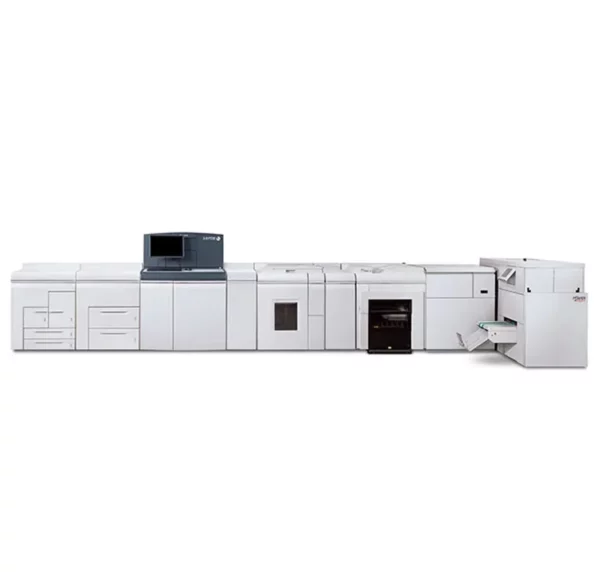
Xerox Nuvera 120/144/157 EA Digital Production System for Black & White Publishing
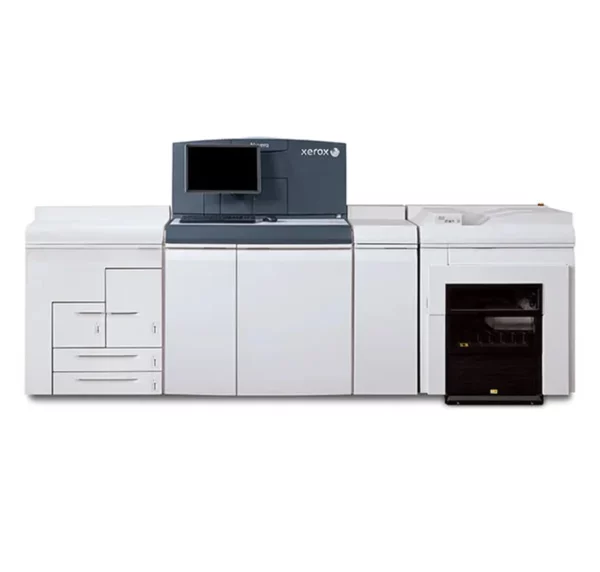
The Xerox Nuvera 120/144/157 EA Series is a monochrome digital production system for organisations whose black-and-white output is counted in millions of pages: commercial printers, book and manual publishers, transactional document centres, print operations in government and banking, as well as individuals or clients whose volumes have outgrown classic repro. The three speeds — 120, 144 or 157 images per minute — are sized for recommended volumes of 1.5 to 2.2 million images per month, with maximum cycles of 3.2 to 4.7 million. A fourth configuration, the NV144EA MICR, prints with magnetic toner for cheques and banking documents — a specialist trade few presses cover.
Image quality is the Nuvera’s historic argument: a 4800 x 600 dpi resolution served by EA toner, for deep blacks, fine detail and a matte, offset-quality finish. Productivity follows: up to 23,200 sheets of paper capacity with loading while printing, stocks from 44 to 300 gsm, extended formats up to roughly 320 x 490 mm, and some fifteen inline and offline finishing options — booklet making, inline binding, perfect binding, hole punching — delivering finished books, manuals and brochures straight off the machine. Specialty media are covered (carbonless paper, tab inserts, tear-proof NeverTear stocks, preprinted offset forms), and third-party feeders plus post-print insertion modules let you integrate colour covers and special pages. The whole system is driven by the integrated FreeFlow print server and automated with FreeFlow Core, while security meets banking-grade requirements: SSL/TLS encryption, authentication, IP filtering and removable hard drives. Sheet-conditioning and cyclonic-cleaning technologies keep quality constant over very long runs.
To place the machine in our catalogue: the PrimeLink B9100, our light-production monochrome multifunction device, tops out at 136 ppm and 700,000 pages per month — the Nuvera begins roughly where the B9100 stops, with volumes five to seven times higher, but without a multifunction’s copying and scanning: it is a press, not a repro machine. Between the series’ three speeds, your actual monthly volume decides; and if your needs exceed even this calibre, the range continues with the Nuvera 288/314. Our advisers will size it with you.
At D&O Partners, the Nuvera Series is available for purchase or leasing, with site study, installation and configuration by our certified technicians, across Belgium. Our maintenance contracts include on-site support and consumables delivered within 48 hours — on machines producing millions of pages, continuity is the real product. Request a quote or a demonstration: we’ll talk actual volumes and applications.
FAQ:
Which Nuvera model should I choose for my volume?
The three speeds share media and finishing; they differ in volume: NV120EA (120 ipm, 1.5 million recommended images per month), NV144EA (144 ipm, 2 million) and NV157EA (157 ipm, 2.2 million), with maximum cycles of 3.2 to 4.7 million. Our certified technicians will size it against your actual volumes.
What is the MICR configuration for?
The NV144EA MICR prints with magnetic toner (MICR) readable by banking processing systems: it is the configuration dedicated to printing cheques and secure banking documents, at 144 ipm and up to 2.8 million images per month.
What is the difference between the Nuvera and the PrimeLink B9100?
An order of magnitude: the B9100 is an intensive repro multifunction device (up to 136 ppm and 700,000 pages per month, with copying and scanning), while the Nuvera is a pure production press whose recommended volumes start at 1.5 million monthly images, with perfect binding, MICR and offset-grade quality that repro does not aim for.
Is the Nuvera suitable for sensitive documents?
Yes, it is built for demanding environments such as banking: SSL/TLS encryption, authentication, IP filtering and removable hard drives guarantee the confidentiality of printed data.
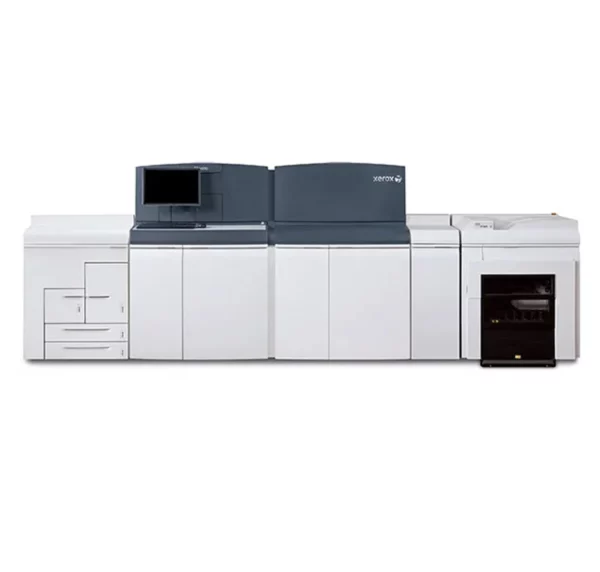
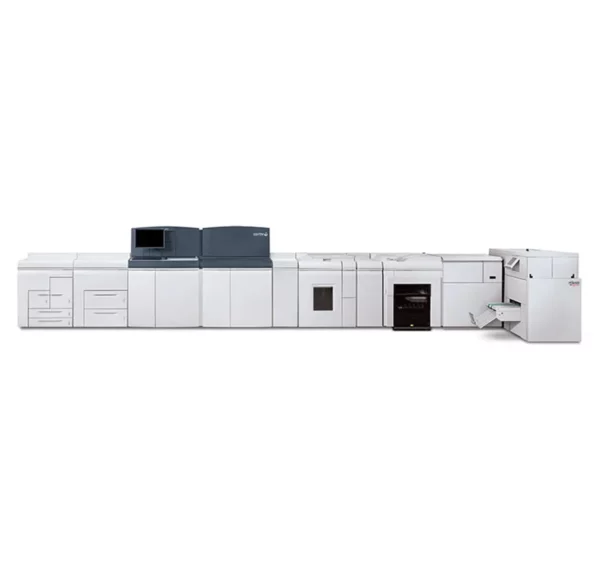
Xerox Nuvera EA Perfecting Production System for Black & White Publishing
The Xerox Nuvera 288/314 EA presses are the monochrome summit of our catalogue: digital production systems built for commercial printers, book and manual publishers, and transactional document centres whose volumes are counted in millions of pages — and for individuals or clients whose black-and-white production runs at industrial scale. The two configurations set the tone: the NV288EA prints at 288 images per minute for a recommended volume of 3 million images per month (up to 7.8 million at maximum cycle), while the NV314EA climbs to 314 images per minute and 4 million recommended images (up to 8.5 million). At this pace, the printer is no longer a piece of equipment: it is the production line itself.
Quality keeps up with volume: the 4800 x 600 dpi resolution and fine-particle EA toner deliver deep blacks, precise detail and a matte, offset-grade finish, consistent across the longest runs. Media flexibility covers stocks from 44 to 300 gsm and formats up to roughly 320 x 490 mm — coated and uncoated papers, carbonless stock, tab inserts, tear-proof NeverTear media and preprinted offset forms —, with a 23,200-sheet capacity reloadable while printing. Some fifteen inline and offline finishing options (booklet making, inline binding, perfect binding, hole punching) deliver finished books and documents straight off the machine, and insertion modules integrate preprinted covers and colour pages. The FreeFlow print server drives it all, automated by FreeFlow Core with intelligent rules and programmed actions, and security meets the most demanding environments: TLS/SSL encryption, authentication, IP filtering and removable hard drives to separate classified and unclassified information.
Within the Nuvera family, the division of roles is clear: the 120/144/157 Series, which shares the same image quality, media and finishing, covers volumes of 1.5 to 2.2 million recommended images per month and remains the only one offering a MICR configuration for cheques and banking documents; the 288/314 doubles the pace and volumes for productions beyond that calibre. If your monthly volume consistently exceeds 2 million images, you are on the right page; below that, the 120/144/157 Series is sized more precisely. Our advisers will settle it with you on your actual figures.
At D&O Partners, the Nuvera 288/314 presses are available for purchase or leasing, with site study, installation and configuration by our certified technicians, across Belgium. Our maintenance contracts include on-site support and consumables delivered within 48 hours — at 4 million pages per month, every hour of downtime has a price, and we know it. Request a quote or a demonstration: we’ll talk actual volumes and cost per page.
FAQ:
What is the difference between the Nuvera 288/314 and the Nuvera 120/144/157?
Image quality, media and finishing are identical; the 288/314 doubles the pace (288/314 ipm versus 120 to 157) and volumes (3 to 4 million recommended images per month versus 1.5 to 2.2). The 120/144/157, however, remains the only one offering a MICR configuration for cheques and banking documents. The right criterion: your actual monthly volume.
Which model should I choose: the NV288EA or the NV314EA?
The NV288EA (288 ipm) is recommended up to 3 million images per month with a maximum cycle of 7.8 million; the NV314EA (314 ipm) climbs to 4 million recommended and 8.5 million at peak. Our certified technicians will size it against your actual production peaks.
What applications does the Nuvera 288/314 cover?
Books and manuals, transactional and promotional applications and direct mail — with perfect binding and inline binding to deliver finished works, and the insertion of preprinted covers or colour pages to enrich documents.
Is the Nuvera 288/314 suitable for sensitive data?
Yes: TLS/SSL encryption, authentication, IP filtering and removable hard drives to separate classified and unclassified information — an architecture designed for secure environments such as banking or government.
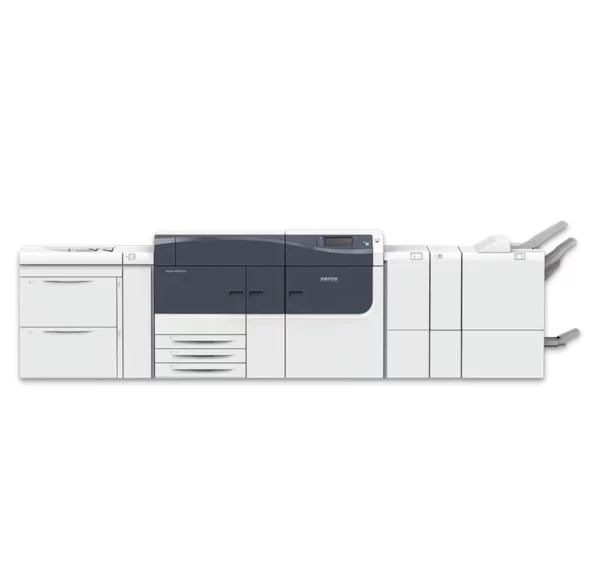
Printing Press Versant 4100 – Xerox
The Xerox Versant 4100 is a digital colour press built for mid-to-high production environments: print shops, high-cadence repro departments and centralised print services, as well as individuals or clients whose daily production demands nearly hands-free quality control. At 100 pages per minute, it is sized for a recommended volume of 350,000 pages per month, with a maximum cycle of 1,800,000 pages — and unlike a production multifunction device, it is a pure printing press, driven by dedicated Fiery servers (Xerox EX-P 4100 or EX 4100).
Its signature argument is automation: the Full Width Array (FWA), an inline full-width scanner fitted as standard, simplifies and automates the most time-consuming tasks — image-to-media alignment, density and solid-area uniformity, colour calibration and profiling. Paired with PredictPrint Media Manager, which manages stocks from the cloud, and with PAR (Production Accurate Registration) technology for precise, consistent front-to-back registration, it makes quality control practically touchless: fewer operator interventions, more jobs delivered. Image quality follows with Ultra HD 2400 x 2400 dpi resolution and 10-bit RIP rendering, served by low-melt, fine-particle EA toner. On the media side, versatility is complete: from 98 x 146 mm formats to extra-long sheets of 330 x 1200 mm, on stocks up to 400 gsm — envelopes, labels, synthetics and banners —, with a maximum capacity of 9,900 sheets and inline finishing ranging from simple folds and staples to full-bleed, square-fold booklets.
Compared with the Versant 280, its smaller sibling, media, formats (up to 1.2 m) and resolution are identical — scale and automation change: the 4100 recommends 350,000 pages per month versus 150,000 (a 1,800,000 ceiling versus 750,000) and carries the FWA quality automation as standard, which the 280 only gets with the optional Performance Package. Conversely, the 280 keeps two assets of its own: the Adaptive CMYK+ specialty toners (gold, silver, white, fluorescents) and built-in copying and scanning. Sustained, automated production: Versant 4100; all-in-one versatility and embellishments: Versant 280. Beyond this calibre, the family continues with the iGen 5 — our advisers will size it with you.
At D&O Partners, the Versant 4100 is available for purchase or leasing, with site study, installation and Fiery server configuration by our certified technicians, across Belgium. Our maintenance contracts include on-site support and consumables delivered within 48 hours — at 350,000 pages per month, production continuity is non-negotiable. EPEAT and ENERGY STAR certified, the press fits into sustainable operations. Request a quote or a demonstration: we’ll talk actual volumes and automation.
FAQ:
What is the difference between the Versant 4100 and the Versant 280?
Media, formats (up to 1.2 m) and resolution are identical; the 4100 climbs to 350,000 recommended pages per month (versus 150,000) and carries FWA quality automation as standard, which the 280 only gets as an option. The 280, however, keeps the Adaptive CMYK+ specialty toners and its copy/scan functions. Volume and automation on one side, versatility and embellishments on the other.
What volume is the Versant 4100 recommended for?
350,000 pages per month in recommended use, with a maximum cycle of 1,800,000 pages — the calibre of a print shop or centralised print service with sustained daily production. Our certified technicians will validate the sizing against your actual volumes.
What does the Versant 4100’s FWA automation bring?
The full-width scanner automates image-to-media alignment, density uniformity, colour calibration and profiling — paired with PredictPrint Media Manager (cloud-based media management) and PAR front-to-back registration, quality control becomes practically touchless: fewer interventions, fewer errors, more production.
Is the Versant 4100 an eco-responsible choice?
Yes: it is EPEAT and ENERGY STAR certified, with low-melt EA toner, and D&O Partners supports you with sustainable consumables management throughout the maintenance contract.
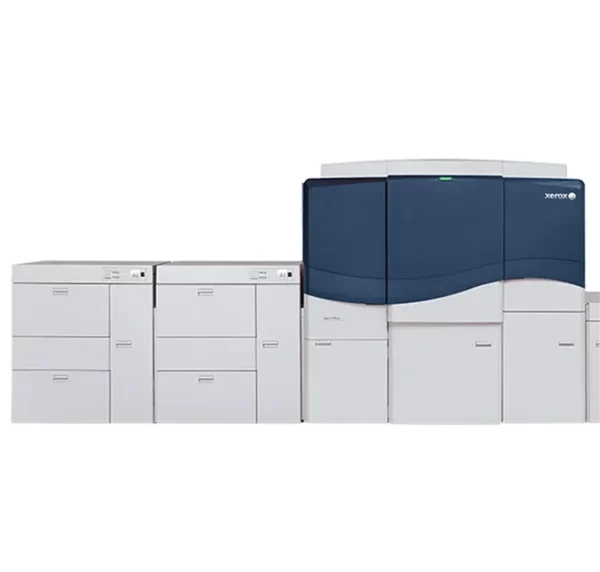
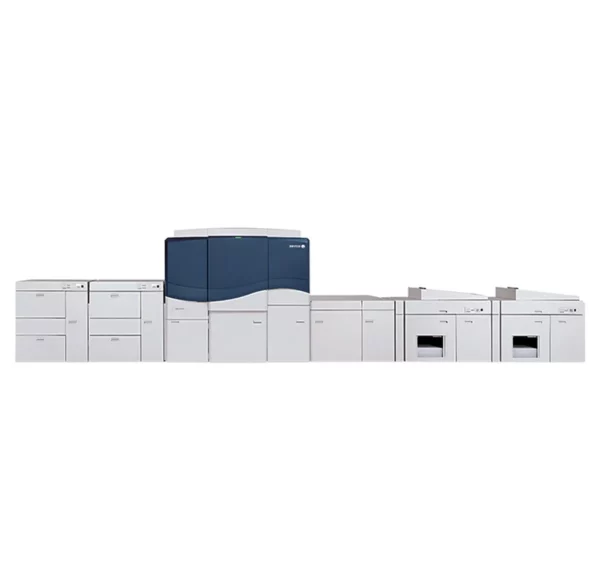
Xerox iGen 5 Press – Digital Printing Press
The Xerox iGen 5 is the digital colour press for high-demand production environments: commercial printers, direct-marketing, photo-book and publishing specialists, as well as individuals or clients whose volumes and colour requirements exceed the scope of classic production presses. Three configurations cover the ramp-up: the iGen 5/90 (90 A4 pages per minute, up to 500,000 recommended pages per month), the /120 (120 ppm, 650,000 pages) and the /150 (150 ppm, up to 1,000,000 pages per month) — driven by either the FreeFlow print server or the Fiery-powered EX-P 5.
Its signature asset is the fifth print station: beyond CMYK, it hosts orange, green or blue gamut-extension toners to reproduce a far wider range of PANTONE colours, or white, clear and fluorescent yellow toners for high-value embellishments and document-security features. Advanced automation does the rest: automatic density control, automatic image-on-paper adjustment and an inline spectrophotometer ensure consistent 2400 x 2400 dpi quality without manual intervention — optionally completed by the Print Inspect Solution, which inspects every page produced. Media flexibility is exceptional: up to 350 gsm as standard and around 530 gsm (610 microns) with the Thick Stock option, sheets of 364 x 660 mm — extendable to 889 mm long with the XLS option on the 120 and 150 models to target new markets —, and a rare range including textured stocks (via Acoustic Transfer Assist, which fixes toner with sound waves), synthetics and even magnetic media (UltraMagnet, DocuMagnet), all in mixed-media runs at rated speed with no drying time before varnishing.
Compared with the Versant 4100, its catalogue neighbour, the split is nuanced: the iGen 5 climbs much higher in volume (up to 1,000,000 recommended pages per month versus 350,000) and opens the chromatic universe of the fifth station, while the Versant 4100 keeps a higher standard stock weight (400 gsm versus 350) and the 1.2 m extra-long sheet as standard. High volumes, extended PANTONE colours and special effects: iGen 5; very heavy stocks and banners in base configuration: Versant 4100. And for metallic and special effects in another calibre, the Iridesse completes the family — our advisers will size it with you.
At D&O Partners, the iGen 5 is available for purchase or leasing, with site study, installation and server configuration by our certified technicians, across Belgium. Our maintenance contracts include on-site support and consumables delivered within 48 hours — fifth-station toners included. Request a quote or a demonstration: we’ll talk profitable applications, actual volumes and return on investment.
FAQ:
What is the difference between the iGen 5 and the Versant 4100?
The iGen 5 climbs to 1,000,000 recommended pages per month (versus 350,000) and adds the fifth print station — extended PANTONE gamut, white, clear, fluorescent — which the Versant 4100 lacks. The latter, however, keeps a higher standard stock weight (400 gsm versus 350) and the 1.2 m sheet as standard. Volume and extended colours on one side, heavy stocks and banners on the other.
Which iGen 5 model should I choose for my volume?
Three configurations: iGen 5/90 (90 ppm, up to 500,000 recommended pages per month), /120 (120 ppm, 650,000) and /150 (150 ppm, 1,000,000). The 889 mm XLS large-format options are reserved for the 120 and 150 models. Our certified technicians will size it against your actual volumes.
What does the iGen 5’s fifth print station enable?
Two families of use: gamut extension with orange, green or blue toners, reproducing a far wider range of PANTONE colours — decisive for brand-colour compliance —, and high-value effects with white, clear and fluorescent yellow toners, which also serve document security.
What specialty media does the iGen 5 support?
A rare range: textured papers (fixed with sound waves via Acoustic Transfer Assist), synthetics, tear-proof NeverTear, DuraPaper and even magnetic UltraMagnet and DocuMagnet media — in mixed-media runs at rated speed, with no drying time before varnishing.
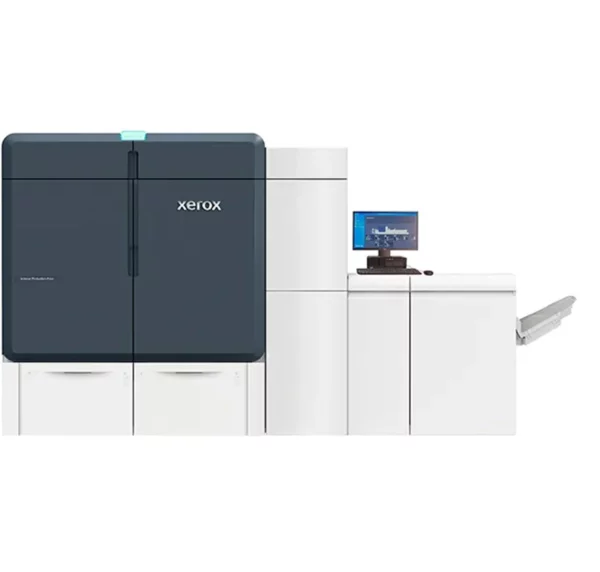
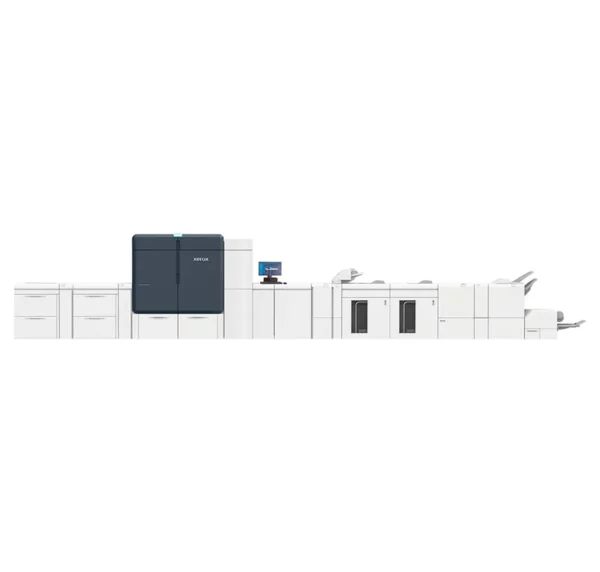
Iridesse Colour Digital Production Press – Xerox
The Xerox Iridesse is the digital production press dedicated to special effects: creative print shops, premium packaging agencies, brand and luxury media specialists, as well as individuals or clients who want to add a genuine “wow” factor to every printed page. At 120 A4 pages per minute, it is sized for a recommended volume of 225,000 to 475,000 impressions per month, with a maximum cycle of 2,250,000 — driven by the Fiery-powered EX-P 6 server, with an optional IPDS software licence available for transactional clients.
Its signature is colour beyond CMYK: the press accommodates up to two additional specialty toner stations, for a total of six colours printed in a single pass, at rated speed, with perfect registration between them. Metallic gold and silver toners create iridescent palettes; white, fluorescent pink and clear toners — the latter low-gloss for textured media — deliver visual effects few presses can reproduce, on coloured or transparent stocks. Automation rests on the Full Width Array, exclusive to Xerox, which speeds up production start-up, and on PredictPrint Media Manager cloud software, which eliminates trial-and-error media setup. The Mixed Media Xceleration feature optimises mixed-media runs, and the Ultra HD 2400 x 2400 dpi resolution with 10-bit RIP processing, powered by Color FLX technology, guarantees offset-grade images — fine detail, smooth gradients, crisp text — even on high-impact jobs. On the media side, the press covers a wide spectrum, from 52 to 400 gsm, with extra-long formats up to 330 x 1200 mm via XLS high-capacity feeders and the Plockmatic MPS XL stacking module, and inline finishing reaching full-bleed booklets in A4 landscape on XLS sheets.
Compared with the iGen 5, its catalogue neighbour, the logic splits clearly: the iGen 5 targets volume, with speeds up to 150 ppm and recommendations up to 1,000,000 pages per month, paired with an extended PANTONE palette or one special effect at a time. The Iridesse focuses on visual effect: up to two specialty stations combinable simultaneously — gold and silver together, for instance — for metallic and iridescent results the iGen 5 does not offer, over a wider range toward lighter stocks. Volume and brand colours: iGen 5; packaging, covers and premium media with combined effects: Iridesse. Our advisers will size it with you based on your applications.
At D&O Partners, the Iridesse is available for purchase or leasing, with site study, installation and Fiery server configuration by our certified technicians, across Belgium. Our maintenance contracts include on-site support and consumables delivered within 48 hours — specialty toners included. ENERGY STAR certified, the Iridesse fits into responsible operations. Request a quote or a demonstration: we’ll talk creative applications, actual volumes and return on investment.
FAQ:
What is the difference between the Iridesse and the iGen 5?
The iGen 5 targets volume (up to 150 ppm and 1,000,000 recommended pages per month) with an extended PANTONE palette or one effect at a time. The Iridesse focuses on visual effect: up to two specialty toner stations combinable at once — gold and silver together, for instance — for metallic and iridescent results, at 120 ppm and 225,000 to 475,000 recommended impressions per month.
How many colours can the Iridesse print in a single pass?
Up to six: standard CMYK plus two specialty toner stations chosen from gold, silver, white, fluorescent pink and low-gloss clear — all printed in a single pass, at rated speed, with perfect registration between colours.
What volume is the Iridesse recommended for?
From 225,000 to 475,000 impressions per month in recommended use, with a maximum cycle of 2,250,000. Our certified technicians will validate the sizing based on your applications and actual volumes.
What media can the Iridesse print on?
A wide spectrum, from 52 to 400 gsm — coated, uncoated, textured, dark, transparent, synthetic and polyester —, with extra-long formats up to 330 x 1200 mm and inline finishing up to full-bleed booklets.